Plumbing
What fails in a guest bathroom that has not been used all year?
Learn which parts of a guest bathroom fail after a year of disuse, from dry drain traps to toilet seals and stale water, and how to check each one.
Standard policies often exclude sump pump overflow. Learn what the endorsement pays, what it leaves out, what it costs and how to avoid denial.
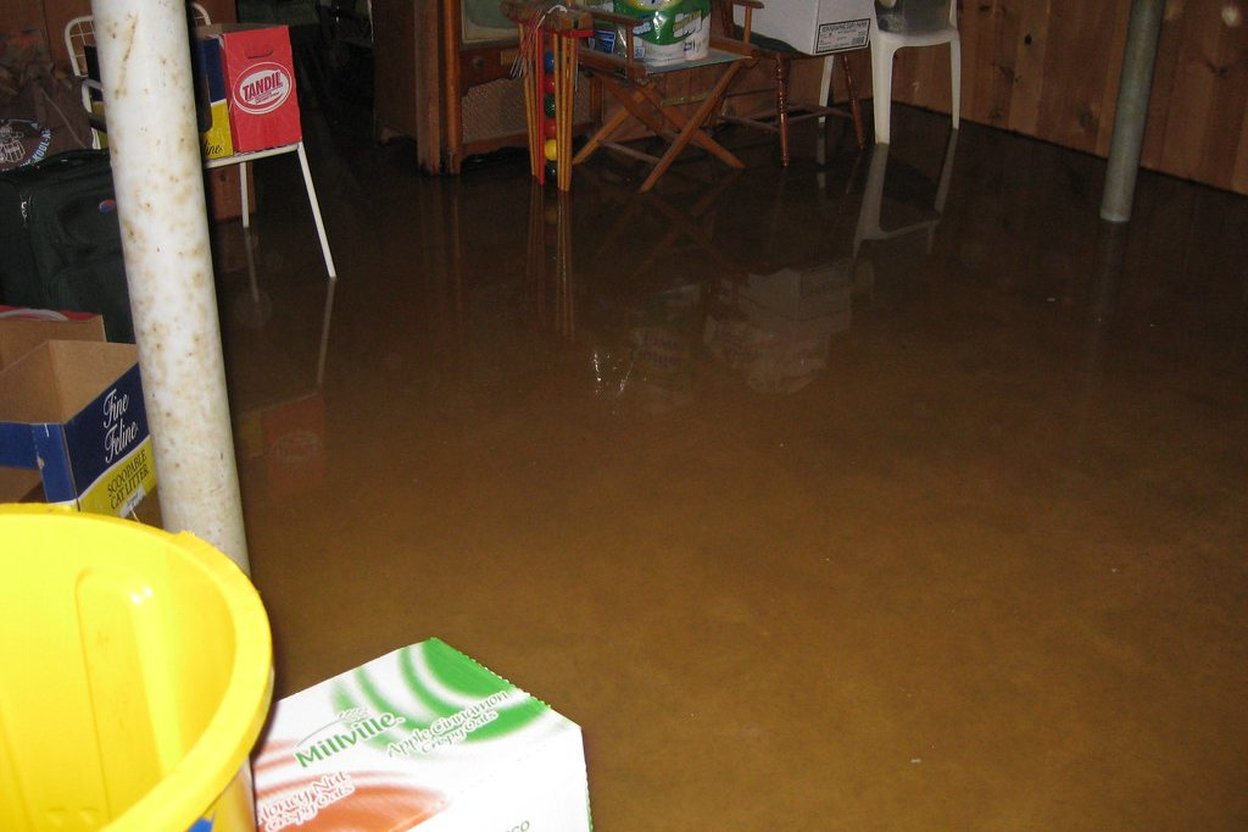
You go down to the basement after a night of hard fall rain, and the carpet squishes under your feet. The sump pit is full, and the pump isn't running. Will homeowners insurance pay for this? Usually not, unless you added a specific endorsement before the water came in. Most standard policies leave out sump pump overflow. This guide covers what that add-on pays for, what it still leaves out, what it costs and how to make a denial less likely.
Most standard homeowners policies exclude water that backs up through sewers or drains. They also exclude water that overflows from a sump pump. If your pump burns out, clogs or can't keep up and the basement floods, the base policy usually won't pay for the damage.
The usual fix is an optional endorsement, often called "water backup and sump discharge or overflow" coverage. Insurers such as Amica and Hippo say it covers "overflows or discharges from sump pumps," including damage caused when the pump fails. The add-on only protects you if it's on your policy before the loss. Adding it after the basement floods doesn't help.
Even with the endorsement, there is a catch. It generally won't pay to replace the pump itself. It pays for the water damage the failure caused. The broken pump is treated as a mechanical failure. Some insurers sell equipment breakdown coverage that may pay for the pump, so ask whether yours offers it.
In short:
Wording varies by insurer and by state. Check the exact language of your own policy before you count on any of this.
When it applies, the endorsement can pay for two kinds of damage:
Power outages are a gray area. Amica says that if a storm knocks out power, the pump stops and the basement floods, the damage may be covered under its endorsement. Not every insurer words it that way. Without the endorsement, a standard policy won't cover it at all. If outage coverage matters to you, ask your agent to show you the clause that covers it.
Even with the endorsement, these are usually excluded:
Exact wording matters, and a recent Pennsylvania case shows how much. A law firm's blog reports that in Tinkelman v. Liberty Mutual, decided August 31, 2026, in federal court for the Middle District of Pennsylvania, a basement took on about 4.5 feet of water. The cause was a discharge pipe that narrowed from about 2 inches to 1 inch, so the pump couldn't move water out fast enough. The claimed loss was more than $100,000. The policy excluded water that escapes from a sump system "for any reason," and the court ruled for the insurer. It was a single trial-level ruling, so it doesn't bind other courts, even in Pennsylvania. Still, it shows how broad exclusion wording can defeat a claim even when the cause is a plumbing defect.
Water backup coverage comes with its own limit, which is the most the insurer will pay for this kind of loss. Limits commonly run from about $5,000 to $25,000. Hippo and Kin describe $5,000 to $10,000 as typical options. Some companies go higher. Openly, for example, offers $5,000, $10,000, $25,000 and $100,000 limits, plus a full-coverage option. Availability varies by insurer and state.
It doesn't cost much. Policygenius estimated about $30 to $70 a year for $5,000 of coverage, plus roughly $25 to $35 for each additional $5,000. Those figures date from 2022, so today's quotes may be higher. Hippo also says the add-on can cost as little as about $30 a year.
Deductibles work one of two ways. Some policies use your regular homeowners deductible, often $1,000. Others set a separate water backup deductible, which can be as low as $250. Ask which one applies, because a $1,000 deductible against a $5,000 limit leaves you with only $4,000 of real protection.
How to pick a limit: walk the basement with a notepad and think about what one bad night could ruin:
For an unfinished basement with a washer, dryer and some storage, a $5,000 to $10,000 limit may be enough. In a finished basement with a family room, guest room or office, that list can climb quickly. Get a quote for the next tier up, because each extra $5,000 usually adds only tens of dollars a year.
Having the endorsement doesn't guarantee a payout. Most denials come down to a few issues.
Maintenance and negligence. Insurers exclude wear and tear and neglect. A pump that was unplugged, switched off, or had a float stuck against the side of the pit can look like negligence instead of a sudden failure.
Age. Amica notes that aging sump systems generally aren't covered, though the water damage they cause may be. Expect the adjuster to ask how old the pump was.
"For any reason" wording. As Tinkelman showed, a broad exclusion can defeat a claim even when the real cause is something like an undersized discharge pipe. In that case, the insurer denied the claim four days after the loss without inspecting the property, and the court still sided with the insurer. A weak investigation by the insurer doesn't create coverage the policy excludes.
Power outages. If your endorsement doesn't clearly include outage-related failures, a storm that kills the power can leave you without coverage.
Records to keep (a folder or a phone album works):
Fall is a good time for this, before late-season storms and well before snowmelt next spring.
If the pump needs replacing, budget roughly $350 to $1,000. A new installation averages about $1,400, and most homeowners pay between $500 and $4,000.
When to call a licensed plumber: call one to replace the pump, fix or reroute the discharge line, replace a check valve, or dig a new pit. Call one too if the pump runs but the water level doesn't drop. If the pump needs a new outlet or a dedicated circuit, that job is for a licensed electrician. Water and electricity share that pit, so if there's standing water near the pump or its outlet, keep out of the water and shut off power to the area at the breaker panel. If you can't reach the panel without walking through water, call an electrician or the utility.
None of this costs much compared with a flooded finished basement. A five-minute bucket test this weekend and a phone call to your agent before Thanksgiving can make the difference between a paid claim and a large bill you cover yourself.
Photo: flooded basement by jeffcovey, BY-SA 2.0.
Learn which parts of a guest bathroom fail after a year of disuse, from dry drain traps to toilet seals and stale water, and how to check each one.
Learn how to find your sewer cleanout, what plumbing codes require, who owns the sewer line, and what a scope or cleanout install costs.
What an inspector looks for on sewer-scope video of Orangeburg pipe: out-of-round walls, blisters, roots, and separated joints.