Exterior
How Mice Get In Every Fall: A Homeowner's Check for Entry Points
Mice need a gap about 1/4 inch wide. Here's where to look outside and inside, what to seal each gap with, and how to clean up droppings safely.
Why gutters overshoot in heavy rain and how to fix it: cleaning, slope, downspout sizing, valley guards, and grading away from your foundation.
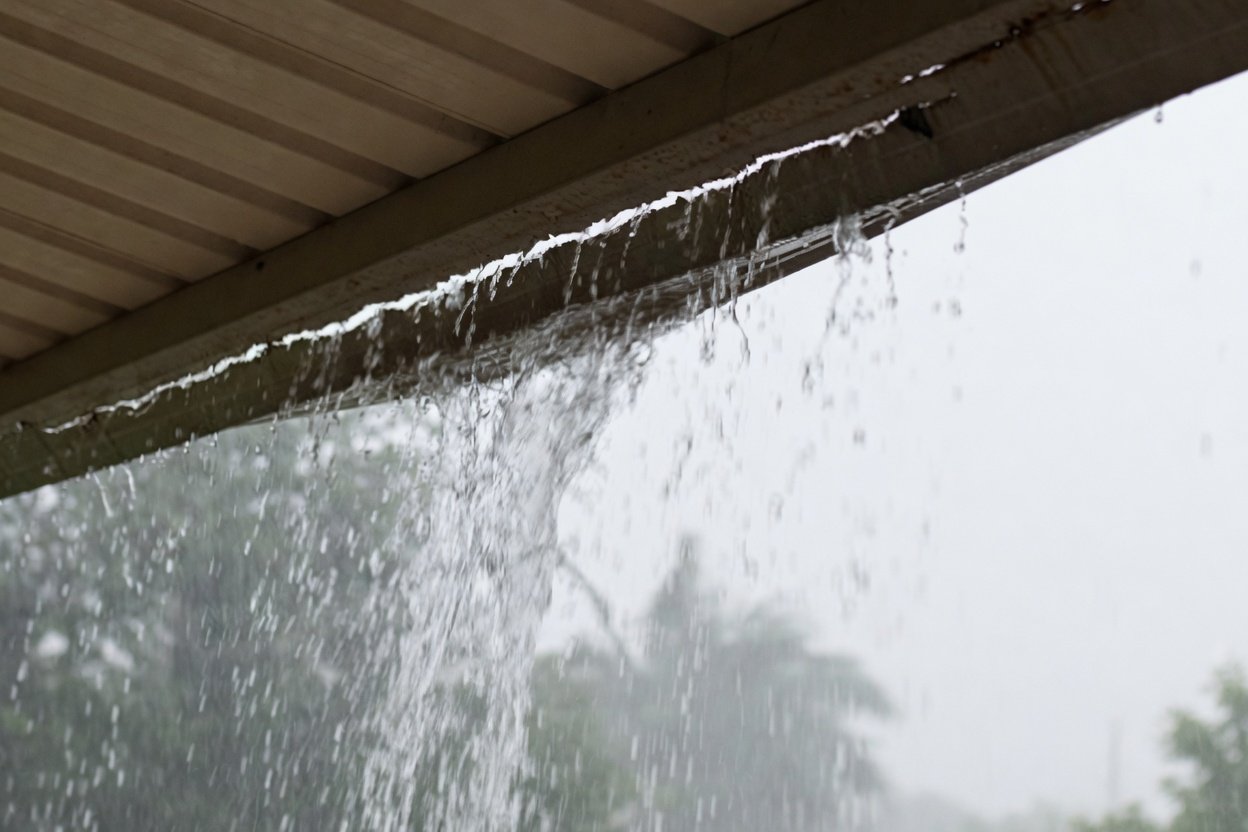
You're at the window during a hard rain, and instead of a gutter quietly doing its job, you see a sheet of water pouring over the front edge and drilling a trench in the flower bed below. That's gutter overshoot. It usually has one of a few causes: debris, the wrong slope, gutters or downspouts too small for the roof, or a roof valley that dumps more water than the gutter can catch. Each one has a specific fix. The last step is making sure the water that does land near the house drains away from it.
Water that overshoots the gutter falls right beside your foundation, which is where it can do the most harm. Many parts of the United States sit on expansive clay soils. These soils swell when wet and shrink as they dry. According to InterNACHI, expansive soils cause more property damage in the U.S. than floods, hurricanes, earthquakes and tornadoes combined. Repeatedly soaking the ground along one wall is exactly the kind of wetting those soils react to.
There's a financial reason to care, too. The Insurance Information Institute notes that homeowners policies cover water damage that is sudden and accidental. They generally exclude damage that builds up gradually from poor maintenance, and neglected or overflowing gutters fall in that category. A leak caused by a clogged gutter you ignored for years is likely your bill, not your insurer's.
A clogged gutter can't carry water, so it overflows at the first heavy rain. Bob Vila and This Old House both recommend cleaning gutters at least twice a year, in spring and fall. If your house sits under heavy tree cover, plan on three or four cleanings a year.
The ladder is the risky part of the job. OSHA's ladder rules are written for job sites, but they make good habits at home:
If you aren't comfortable on a ladder at that height, hiring someone for this job is money well spent.
Gutters need a slight slope so water runs toward the downspout instead of sitting in the trough. This Old House and Blue River Gutters both give the standard residential pitch as about a 1/4-inch drop for every 10 feet of run.
More slope is not better. Blue River Gutters notes that a steep pitch, such as 1 inch per 10 feet, leaves the low end of the gutter too shallow and makes water splash over. Overshoot at the low end of a long run can be a sign of exactly this problem.
That gentle 1/4-inch-per-10-feet pitch is far too small to read reliably with a spirit level. A level tells you whether something is flat, not whether it drops a fraction of an inch over 10 feet. A better method:
The slope is only part of what moves water. The Sheet Metal and Air Conditioning Contractors' National Association (SMACNA) publishes the standard many gutter designers work from. Its manual treats a gutter sloped 1/16 inch per foot or less as having the same capacity as a level gutter. The standard pitch is well under that. In other words, the slope keeps water from standing in the trough, but it does little to increase how much water the gutter can carry.
Stricter numbers apply in one case. Where gutters feed a rainwater-collection system, the International Plumbing Code and International Residential Code require a slope of at least 1/8 inch per foot toward the collection point, with no pooling.
Since slope adds little capacity, a gutter that overflows in every downpour, even when clean and properly pitched, is often too small. Sometimes it simply has too few exits.
SMACNA's sizing method does not use roof square footage alone. It works in two steps:
SMACNA offers a free online calculator that runs these numbers.
Downspouts matter as much as the gutter itself. According to Premier Gutters, a standard 2x3-inch downspout drains roughly 600 square feet of roof. A larger 3x4-inch downspout handles about 1,200 square feet. Upgrading to the larger size, or adding a downspout, is often cheaper than replacing the gutters.
For spacing, common industry guidance calls for one downspout every 30 to 40 feet of gutter. In areas with intense rain, on steep roofs, or where runoff concentrates, that tightens to every 20 to 30 feet. SMACNA also recommends that a continuous gutter run served by a single downspout not exceed 50 feet. That limit helps prevent backups and leaves room for the metal to expand in heat. Treat these spacing figures as starting points. The real answer depends on how much roof drains into each section and how hard it rains where you live.
Even a well-sized gutter can be overwhelmed at one spot. Roof valleys, where two roof planes meet, funnel water from both slopes into a single fast stream. That stream can shoot straight over the gutter's front lip. Inspecting the valley won't stop it. A physical fix will.
A valley splash guard, sometimes called a gusher guard, is a short metal piece that mounts upright on the gutter's front edge, right below the valley. It knocks the fast-moving water back into the trough. Family Handyman and This Old House both describe fastening one by drilling 1/8-inch holes through the guard and the gutter lip and riveting them together.
A related trouble spot is where a roof edge runs into a sidewall, such as a second-story wall or a dormer. The International Residential Code requires a kick-out flashing there, made of corrosion-resistant metal at least 0.019 inch thick (No. 26 galvanized steel). It turns the water out into the gutter so it doesn't run down the siding. If you see water stains streaking down the wall below one of these corners, check for a missing or bent kick-out.
Gutter guards can cut down on cleaning, but some designs make overshoot worse. Reverse-curve guards rely on surface tension: water clings to the curved nose and wraps around into the gutter while leaves slide off. Today's Homeowner notes that in heavy downpours or on steep roofs, the water moves too fast to cling and sails right past. Micro-mesh guards let more water in while still blocking debris, so they're usually the safer choice where overshoot is already a problem.
Keep in mind that splash guards and leaf guards solve different problems. Splash guards redirect water but do nothing about debris. Leaf guards keep debris out but don't stop a valley's torrent.
Fixing the gutters controls where the water lands. The ground has to carry it the rest of the way. The International Residential Code requires the soil around a foundation to fall at least 6 inches within the first 10 feet. Patios, walks and other hard surfaces next to the house should slope at least 2 percent away from it. If the yard pitches toward the house, water will collect at the foundation no matter how well the gutters work.
If overshoot has already soaked a basement or wall, act quickly:
The good news is that most overshoot traces back to something you can see and fix, whether it's a clogged trough, the wrong slope, a missing downspout, an unguarded valley, or ground that slopes the wrong way. Fix the cause, and the next storm should drain the way it's supposed to.
Mice need a gap about 1/4 inch wide. Here's where to look outside and inside, what to seal each gap with, and how to clean up droppings safely.
Basement window wells flood, collect leaves, trap animals, and sometimes are the only way out in a fire. How to check the well, the drain and the cover, and what makes a…
Snow adds weight to a deck that's been baking and soaking all year. How to check the ledger board, flashing, posts, fasteners, railings and stairs in an afternoon, and the warning signs…