Inspection FAQ
Credit or repairs. What buyers are asking for after the report
Compare a repair credit, completed repairs, and a price cut after a home inspection, with loan limits and how to get terms in writing.
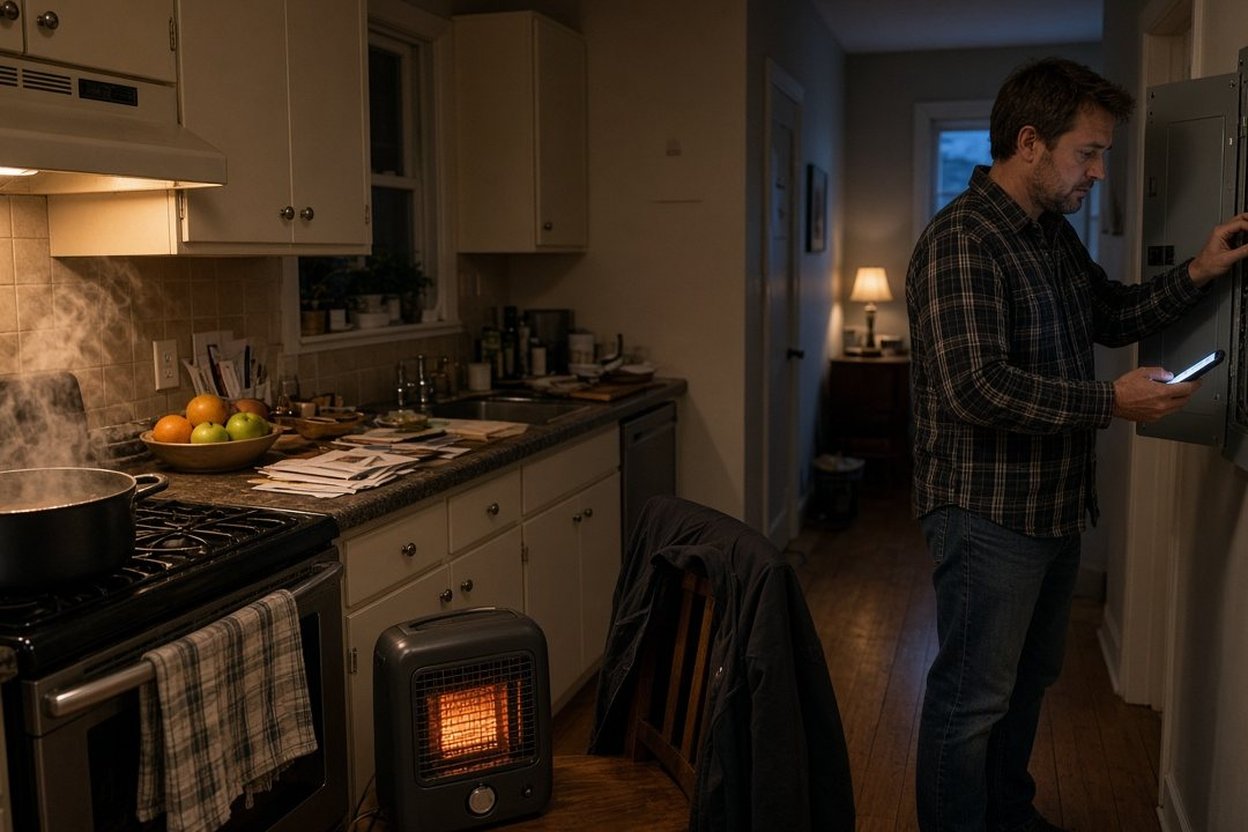
Find out if your kitchen can run an oven and space heater together, and how to safely check your breaker panel.
It's a cold fall morning. The oven is preheating, maybe for a practice pie before Thanksgiving, the kitchen floor feels like ice, and you want to plug in the space heater. In most houses wired to current practice, a built-in electric oven and a plug-in heater can run at the same time. They aren't on the same circuit. The real risk is the heater sharing the counter outlets with a toaster oven, coffee maker or microwave. Here's how to tell which situation your kitchen is in.
How much the oven matters depends on what kind of oven you have:
A kitchen built to current rules has several circuits. Each one has a job.
Small-appliance circuits. Countertop receptacles need at least two 20-amp, 120-volt small-appliance circuits. Those circuits also cover the pantry, breakfast room and dining room receptacles. They may not feed light fixtures, and one circuit may not serve more than one kitchen. The only exceptions are a clock receptacle and the gas-range receptacle.
The oven or range circuit. An electric oven gets an individual circuit sized from its nameplate. GE's chart for one wall oven at 240 volts:
A household range rated 8¾ kW or more needs at least a 40-amp circuit.
Wire size and breaker size go together. A 15-amp breaker protects 14-gauge copper, a 20-amp breaker protects 12-gauge copper, and a 30-amp breaker protects 10-gauge copper. The breaker is there to protect the wire.
Older kitchens are different. Many older houses have 15-amp counter circuits. Some have kitchen outlets on the same breaker as a bedroom or living room. Cities and states also adopt different editions of the National Electrical Code, and existing wiring doesn't update itself when the code changes. The panel in your house tells you what you have. The code book only tells you what's supposed to be there.
A typical portable heater, such as a listed Lasko 1,500-watt model, is rated at 12.5 amps (1,500 watts ÷ 120 volts). For a cord-and-plug appliance, that's about as big as it gets.
Here are the limits it runs into:
That 80 percent figure comes from two rules. First, on a circuit with more than one outlet, no single plug-in appliance should be rated above 80 percent of the circuit. Second, a continuous load (one running at full current for three hours or more) has to be sized at 125 percent, which works out to the same 80 percent limit. A heater with a thermostat cycles and may not technically count as continuous. Still, 80 percent is the right planning limit for a heater you leave running.
The heater alone is already over the 12-amp mark on a 15-amp circuit. Listing labs can approve portable products up to the full circuit rating, which is why 12.5-amp heaters with ordinary plugs are still on store shelves.
Now add some common kitchen appliances to a 20-amp counter circuit:
To sum up: a heater alone can fit on a 20-amp counter circuit. A heater plus almost any other appliance that heats something can't.
Use the breaker panel, not the outlet. The outlet's face won't tell you the circuit's rating.
Stop using the outlet if:
A breaker that keeps tripping is doing its job: it's protecting the wire from overload. Swapping a 15-amp breaker for a 20-amp one on 14-gauge wire doesn't fix anything. It removes the protection.
The basic safety rules from the Consumer Product Safety Commission (CPSC) and the Electrical Safety Foundation International (ESFI):
The fire numbers come from different agencies counting different things, so each one appears here with its source:
If the counter circuit can't carry the heater along with what you cook, the fix is a new 20-amp circuit. That's panel work, and it's a job for a licensed electrician. Most jurisdictions require a permit for it.
Prices checked in 2026 vary widely:
What drives the price is how far the outlet is from the panel, whether the electrician has to run wire through finished walls, and whether the panel has room for another breaker.
Compare a repair credit, completed repairs, and a price cut after a home inspection, with loan limits and how to get terms in writing.
Learn why an inspection report is not a repair list, how to sort findings into repair, monitor, and evaluate, and make a focused request.
A thermal camera flags possible moisture, missing insulation, air leaks and hot wiring. Learn what a scan can and can't confirm, and what it costs.