Each animal has its own schedule and its own kind of mess. Squirrels make fast scampering and rolling sounds at dawn and dusk and chew golf-ball-sized holes at the roofline. Raccoons are heavy, loud at night, and leave droppings piled in one spot. Bats are quiet. You'll mostly see them pouring out of a gap at dusk, and the droppings pile up under where they hang. Before you seal anything, find out which one you have. Bats are protected under state law, and in most states sealing them in or killing them is illegal.
Fall is when all three start looking for a warm place to spend the winter. Here's how to read the signs and what to do about each one.
01Listen first: when the noise happens tells you a lot
Before you climb into the attic, just pay attention for a few days and write down when you hear things.
- Dawn and dusk, fast scurrying, things rolling, chewing: most likely squirrels. They're out during the day and come home around sunrise and sunset. A rolling sound is often an acorn or nut being moved around.
- Late at night, heavy thumps, walking, sometimes growling or chattering: sounds like something much bigger than a squirrel, which usually means a raccoon. In fall a raccoon may be setting up a den for the winter.
- Around dusk, faint scratching or squeaking near one wall or the peak, then nothing: could be bats crawling toward their exit. Lots of people only find out they have bats when one shows up in the living room.
If the noises are coming from the walls, ductwork or framing and don't follow any of these patterns, look at which house noises are normal at night before you assume something's living up there. Small scratching inside walls is often mice, and they're a different job. See how mice get in every fall.
02Walk the outside: look for the way in
On a dry afternoon, take binoculars and walk all the way around the house. Most entry points are along the roofline, the same spots you'd check in a roof inspection from the ground.
Check these spots:
- Soffit-to-fascia corners. This is the classic squirrel hole: a roughly round opening about the size of a golf ball. Fresh chewing shows lighter than the weathered wood around it.
- Gable vents and roof vents. Look for bent louvers, torn screen, or plastic vents with chewed edges.
- Gaps around pipe boots, chimney chases and where a dormer meets the roof. If there's an unused flue or the cap is missing, check that too in your chimney check before the first fire.
- Dark staining or rub marks at a narrow gap near the peak, a corner board or under flashing. Bats can crawl through an opening only about half an inch wide, so a gap that looks too small to matter can still let them in.
- Torn shingles, peeled-back soffit panels or a pulled-loose vent. That kind of damage takes some strength, so it usually means a raccoon.
- Clues on the ground. Tufts of insulation on the lawn, shredded bits near the foundation, or droppings collecting on a windowsill or deck under one spot on the roof.
According to wildlife control companies, a squirrel can chew a half-inch gap big enough to get through in about a day, and a gray squirrel can fit through an opening around 1.5 inches. So a gap you saw last spring isn't the same gap now.
03Inside the attic: what to look for (and what not to touch)
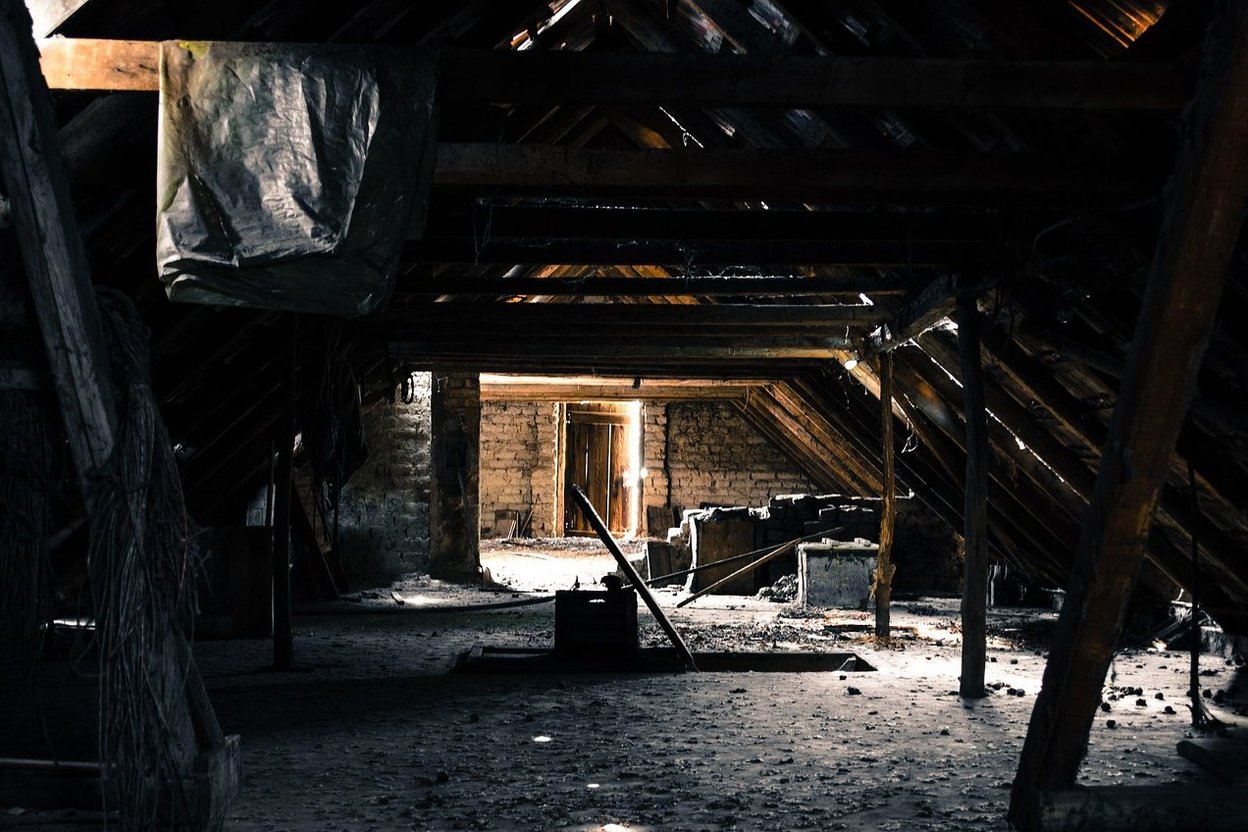
Take a good flashlight, wear gloves and an N95 mask, and step only on joists. You're looking, not cleaning. If you haven't been up there in a while, do the attic insulation and ventilation check on the same trip.
Signs by animal:
- Squirrels: tunnels and nests in the insulation near the eaves, chewed wood or wire insulation, nutshells, droppings spread around the area they use.
- Raccoons: insulation flattened into wide paths, torn ductwork or vapor barrier, and a latrine: one area where the droppings pile up. That pile is the most dangerous thing in the attic.
- Bats: a pile of droppings directly under a spot along a rafter or near the peak, staining on the wood, and a strong ammonia smell from urine if the colony is big.
Do not chewed-on wiring and walk away. Chewed wire insulation is a fire risk. Note where it is and have an electrician look at it once the animals are out.
04The health risks are real
Raccoon droppings can carry raccoon roundworm (Baylisascaris procyonis). The CDC says the eggs can survive in the environment for years, and people get infected by swallowing them, so young children are at the highest risk. CDC guidance for cleaning up a latrine calls for disposable gloves, rubber boots and an N95 respirator, and for heat (boiling water or a propane torch) on surfaces where you can use it safely. Inside a wood-framed attic, that's a job for a remediation pro, not you with a torch.
Bat droppings (guano) that pile up can hold the fungus that causes histoplasmosis. You get it by breathing dust when dry droppings get disturbed. A few scattered droppings are low risk. A real pile is a job for a professional with respirators and containment. Don't sweep it and don't shop-vac it.
Bats and rabies: the CDC says most people in the U.S. who die of rabies were exposed to a rabid bat, and that bat bites can be so small you may not know you were bitten. If a bat ends up inside your living space, don't swat it out the window and forget about it. Put on leather work gloves, contain it if you can do that safely, and call your local health department before you let it go. They'll tell you whether it should be tested.
05Bats: the fall rules are different
This is where homeowners get in trouble. Bats are protected by state law across the country, and some species are federally endangered. Poisons, fumigants and killing them are generally off the table. The legal method is exclusion: you put one-way devices over the entry points so bats can leave but can't get back in, then seal the openings permanently once they're all out.
Timing matters, and it depends on the state:
- Florida prohibits exclusion from April 16 through August 14 (maternity season). Outside that window, the one-way device has to stay up for at least four nights when overnight lows are forecast to be at least 50°F.
- Missouri's extension service warns that excluding from mid-May through mid-August traps young bats inside, and it calls November through March the best time to bat-proof, after the bats have left.
- Pennsylvania wildlife control companies cite a no-exclusion window of May 15 through July 31.
The catch in fall: some bats, especially big brown bats, don't leave. They can hibernate in walls and attics through the winter. If you seal every gap in October with them still inside, they die in the wall, you get the smell, and you may have broken your state's law. Bats that get forced out into freezing weather may not survive either.
What to do instead:
- Do a dusk watch. Start about 30 minutes before sunset, put someone on each side of the house if you can, and count anything that comes out. Missouri Extension says the last bat usually leaves within an hour of the first.
- If bats are still coming out, don't seal anything. Call a wildlife control operator who does bat exclusion, and check your state wildlife agency's rules on dates and methods.
- If you see no bats on a few warm evenings but you do find old droppings, have a pro confirm the roost is empty before anyone seals it.
06Squirrels and raccoons: don't seal one in, either
In early fall, gray squirrels may have a second litter in the attic. If you seal the hole while babies are inside, the mother will chew a new hole, often right next to the old one, and anything left inside dies in your attic.
The approach that works is the same as for bats: get them out first, then seal. Pros use one-way doors over the main hole, and they make sure no young are left behind. Trapping and relocation rules for squirrels and raccoons vary by state, and some states don't allow you to relocate wildlife at all, so check your state's rules before you set a trap.
Once they're out, seal with materials they can't chew. Squirrels go through wood, plastic and thin metal, so heavy galvanized hardware cloth or sheet-metal patches screwed down are the usual fix. Expanding foam on its own doesn't hold.
07What it costs to hire it out
As of October 2026, Bob Vila puts typical removal at about $400–$600 for raccoons, $200–$600 for squirrels and $230–$700 for bats. Those numbers usually don't include the full job. Cost guides show complete bat exclusions for large colonies running into the thousands, and replacing insulation fouled by droppings can add roughly $1,000–$2,150.
Before you sign, ask whether the quote includes:
- Finding and sealing every entry point, not just trapping the animal
- A warranty on the sealing work
- Cleanup of droppings and nesting, or whether that's a separate bid
- For bats, confirmation that the timing follows your state's rules
A cheap trap-and-haul quote that leaves the hole open just means you'll get another animal in that hole next month.
08Your fall attic-pest check
- For three or four days, write down when you hear noises (dawn and dusk, late night, or at sunset).
- Walk the roofline with binoculars: soffit corners, vents, chimney, dormers.
- Check the ground for insulation tufts and droppings under one spot on the roof.
- Look in the attic with gloves and an N95. Look, don't clean.
- Do a 30-minute dusk watch before you seal anything.
- If it's bats, or if there's a raccoon latrine or a guano pile, call a pro and check your state wildlife agency's rules.
- Get everything out, then seal with metal, then fix chewed wiring and fouled insulation.
Related: Fall Home Inspection Checklist: 20 Things to Check Before the First Freeze
Sources (6)
Photo by Kincse_j on Pixabay.